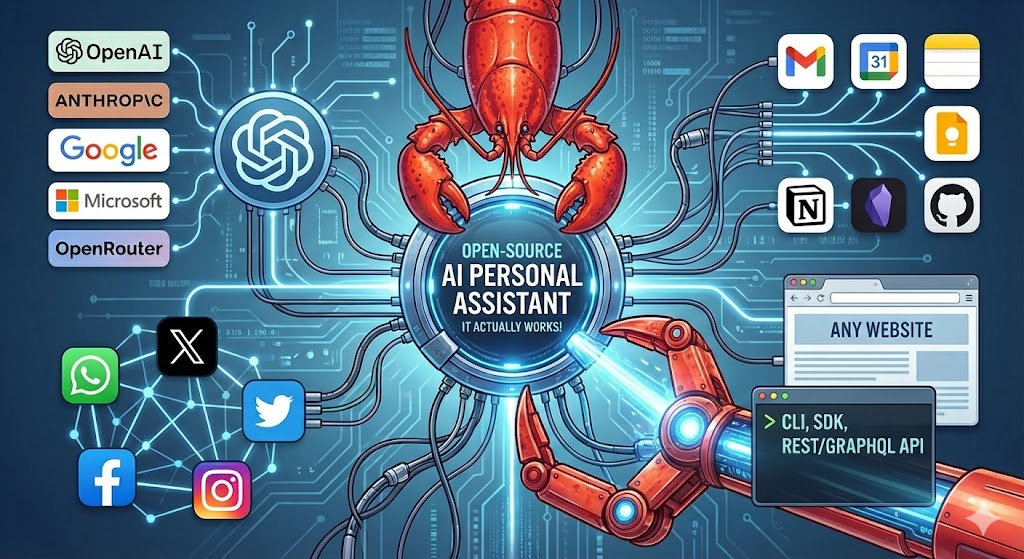
OpenClaw (formerly clawdbot), released in early January, lets you create automations for any task you can run on a computer, using natural language (English, Portuguese, Spanish).
It's a powerful new abstraction layer that turns words, written in a chat, into automated processes.
In this article:
Possible automations
You know that electricity bill you download every month from the utility company's website? You can automate it.
That recurring (or one-off) purchase you make on iFood/Amazon/Mercado Livre? You can automate it, though I don't recommend it (for security reasons). Unless you use a prepaid card 🤙.
Every digital task can be automated: at least, the ones that can be described as input (data), expectation (tasks), and output (results).
Here's a list of other examples
The real value of the tool is
Cron jobs + LLM with function call + integrations.
With access to your browser, terminal, email, calendar, social networks, and an "artificial intelligence" capable of executing functions, it feels like nothing is impossible anymore.
This automation power should accelerate (even more) the pace of product launches and information exchange on the internet.
What changes?
Knowing the syntax of programming languages became, overnight: a lot less important.
Software engineering and system design concepts became: a lot more important.
The dev who understands business rules and takes risks in the product space just got more powerful.
The act of writing code by hand became, in most cases, irrelevant.
Given the speed (and quality) of the new models + the tools being built with them, it's fair to say:
Digital automation has arrived, and with it a new era: large-scale digital production.
Risks
Of course, there are risks of:
- Security
- Quality
- Killing the internet (dead-internet theory) -- well explained in the talk: The end of the internet - André Staltz
(Yes, I used --, but I wrote it myself)
But just like the cellphone, the internet, Alexa, and ChatGPT, I feel it's inevitable.
It's too good not to use: and it's now at its worst version, since it gets better every day.
So what?
I fear the future I don't understand, but as a tech professional who has no intention of losing my job, I choose to learn these tools — at my own pace.